
Listen to this Article
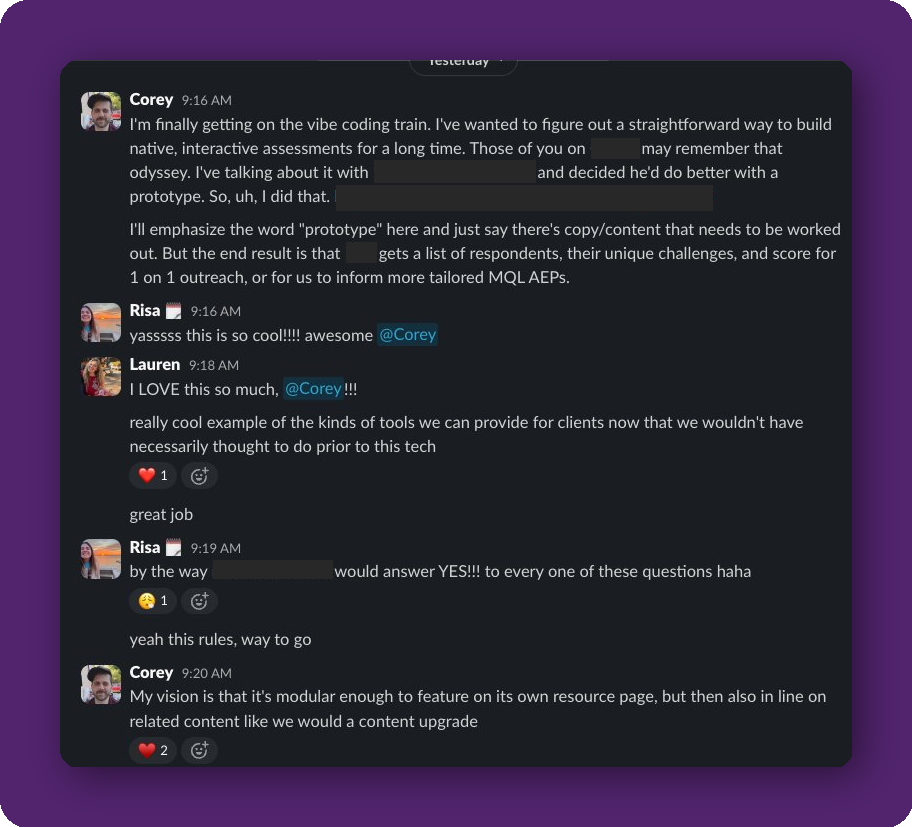
A few weeks ago, one of our senior marketing strategists dropped a link in our internal Slack with a message that impressed the hell out of us. He’d built a fully interactive client assessment tool on his own, using AI. Not a rough sketch. A beautifully designed working prototype with scored responses, tailored outputs, and a clear vision for how it could live on his client’s resource page or feed their MQL pipeline.
The thing is, this particular person wasn’t typically first in line to chase the new thing. Brilliant? Yes. Discerning? Absolutely. But not someone who went off and built something unprompted. Until he did.Our head of client engagement’s reaction in the thread said it all: this rules. The team piled on with excitement, and someone immediately pointed out how perfectly it would map to two of our other existing clients.
Moments like that used to be rare. Now they happen almost daily. An account manager solves a dev problem on her own. A strategist produces a designed client deliverable without touching the design team. A designer folds competitive research into their work because the tools made it possible and they were curious. The lines between roles are blurring, and we’re welcoming it. As our Chief Design Officer put it this morning: we’re removing all obstacles to creation. We’re all builders now.
That’s a new identity for a lot of our staff. And instead of this change making them feel as if they’re outsourcing the creative parts of their job, we’re finding it’s actually increasing the pride our people take in their work. Someone drops a link to something they made and they’re excited to share it with the rest of us. They’re proud of it. And it gets everyone thinking about what else is possible.
That’s what a healthy AI culture looks like from the inside. Getting there is the part nobody talks about honestly enough.
The Part Nobody Says Out Loud
Agency owners right now are under enormous pressure. They know they have to transform to survive, not just to grow margins. They know that transformation is probably going to require hard decisions about their teams. The worry is constant. Who stays, who goes? How do you lead a team through that kind of change while also asking them to learn an entirely new way of working? How do you sit with the guilt of it all, for the people you part ways with and for the ones who remain, who have to process the loss of their colleagues while also showing up every day?
It’s a lot to carry. And I think most owners are carrying it quietly, because there’s no simple answer. There’s certainly not an easy one.
From the other side of some of those decisions, what I can tell you is that there is a way through it. It probably won’t be without real pain. Ours wasn’t. But it’s possible to come out the other side with a team that’s more capable, more energized, and more proud of their work than before.
You’re probably grappling with two related questions: how do I get my team to actually use these tools, and how do I shift the culture so that AI feels like a natural part of how we work? They’re not separate problems. But the culture piece is harder, takes longer, and matters more in the end.
We’ve been working on it for three years. These are a few of the things I’ve learned along the way.
The mindset shift doesn’t happen in a meeting. It happens the first time the tool actually works.
We’ve introduced new tools to our team in a lot of different ways: demos, walkthroughs, documented processes. And I’ve watched the same thing happen each time. The team is receptive, even interested, but not yet converted. They understand the concept. They don’t yet believe in its impact.
Then they use the tool themselves. They ask it for something and it actually works. It does what they need it to do. And something visibly changes. There’s a moment where the person goes from “I get what this does” to “wait, what else could I do with this?” Once it happens, you can’t un-ring that bell. They start bringing ideas. They start sharing wins with each other. They start approaching client problems differently.
You can’t manufacture that moment with training materials. You have to build tools that are good enough to produce it.
What changes when the old constraints go away.
Before we rebuilt around AI, creative problem-solving had real ceilings. The team had ambition. Time and resources didn’t always cooperate. A strategist might see an ideal solution to a client problem, something that required pulling together competitive research, a design asset, a written deliverable, and some data analysis. She knows it’s the right answer. But she also knows what it would take: pulling in the writer, the designer, the analyst, coordinating across schedules, probably compressing someone else’s timeline. So she scales back. She proposes something smaller, something feasible. The client gets a good answer instead of the right one.
When those constraints started to fall away, something opened up. People began imagining more freely, reaching for what would actually be best for the client, and finding that more of it was now possible. Because our tools are built well enough to deliver on that vision consistently, the result is something the team member is genuinely proud of. It was their idea; the tools made it possible.
Take our email team. Before, building a client email meant fighting with the template system inside our marketing automation platform, and if you’ve ever done this, you know exactly what that looks like. Strange rendering, inconsistent spacing, troubleshooting that eats an hour before you’ve even started on the content. It’s a headache. Now our team (enabled by our tech) builds every single email in custom HTML, bypassing the template system entirely. The emails render more consistently, they’re more stable across clients and devices, and they’re faster to produce. The strategist directing the work isn’t managing a finicky builder anymore. He’s focused on the email itself.
The pride is real because the ownership is real.
One of the fears I hear most from agency owners is that AI will hollow out their team’s sense of craft, that people will feel like operators of a machine rather than makers of something. I worried about that, too.
What I’ve seen is the opposite. When our strategist uses these tools to do the deepest competitive research of her career and arrives at a positioning recommendation that a client wants to adopt globally, that’s her work. The tools gave her a research depth and a brainstorming buddy she never had access to before. But the thinking? The judgment? That was all her.
When our Director of Operations implements a client’s design/content requests herself without needing to pull in a developer, she doesn’t feel diminished. She feels more capable than she ever has in that role. She’s proud and she wants to share it with her colleagues.
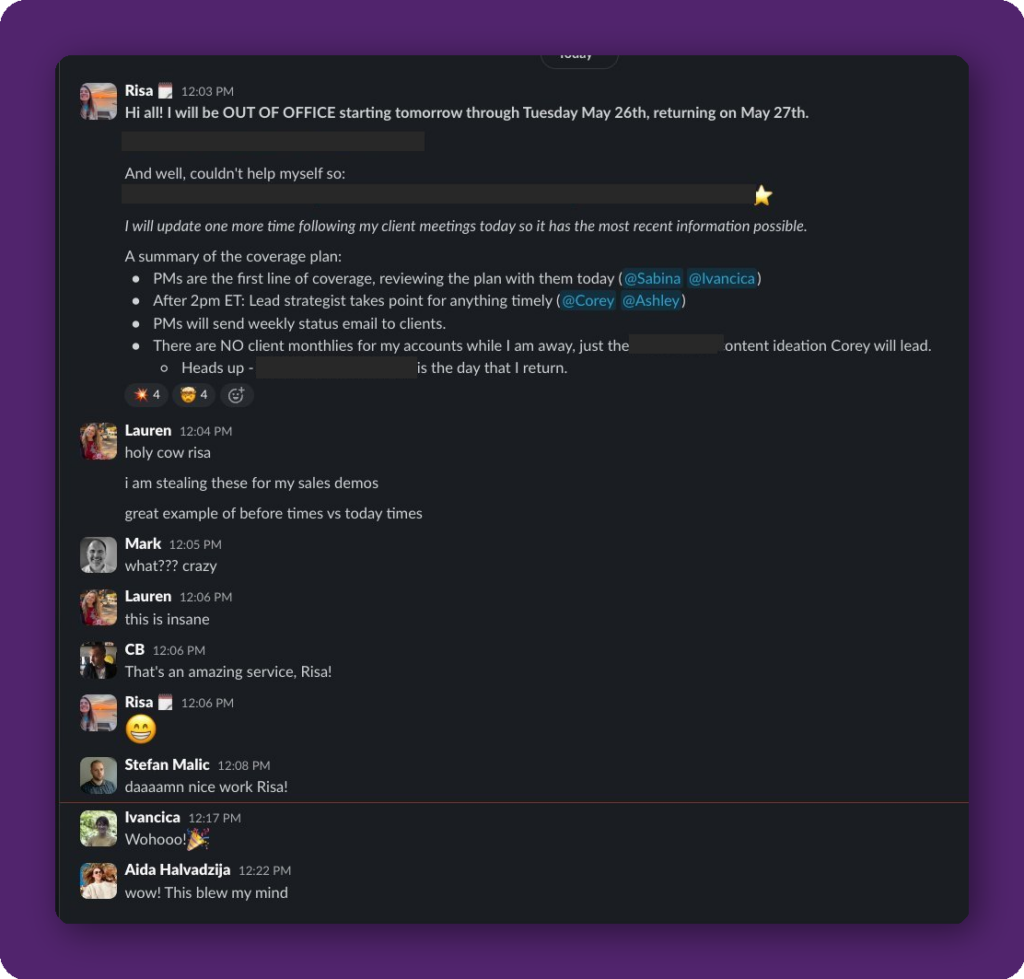
One of our account managers went on vacation last week. Before she left, she posted her out-of-office coverage plan to Slack. The usual Google doc version. And then: “And well, couldn’t help myself.” She’d built a custom HTML version that pulled live from our project management system: every in-flight task, who owned it, what needed to happen while she was gone, all filterable by client and team member. She linked it right next to the original.
Nobody asked her to do that. It wasn’t billable. She just saw a better way to do something she’d always done and built it. We were all blown away. Same person. Different capability.
What this requires from leadership.
I want to be honest here: this has been a journey for us, and it wasn’t a clean one. Getting to the culture I’m describing required some genuinely painful decisions. We had to let good people go. Multiple times. We have fewer writers and designers on staff than we used to, for example. We also stumbled in places. Some tools we built didn’t land the way we hoped. We had to reconstruct workflows again and again (and again). Sometimes we moved faster than the team was ready for.
But we also got some things right, and I think they made the difference.
1. Don’t ship a mediocre tool.
About three years ago, when AI writing tools started flooding the market, we encouraged our writers to use them. Jasper, Writer, early GPT. We believed that if they pushed these tools hard enough, they could produce work at the same standard but faster. Our writers bristled, and honestly, we weren’t as sympathetic as we should have been at first. These were people who had spent their careers developing a craft. Of course they were skeptical. We pushed anyway, and eventually caught on: the tools weren’t ready, and we were actually making our writers slower.
So we built something ourselves instead: a content system built around our own IP. Our strategy team’s framework for ideating topics that actually break through. Our writers’ approach to client interviews. A drafting layer that referenced each client’s style guide and stripped out AI-speak. It worked. Our writers were proud of what came out of it.
That was our first real lesson in what it means to build tools worth using. What we build today looks nothing like that. We’re building client intelligence agents that remember everything about every account and make that intelligence available to everyone on the team, instantly. We’re building operational dashboards that streamline our financial reporting and forecasting. We’ve got design systems that make every client deliverable (presentations, reports, assessments, ad creative) consistent, beautiful, and produceable by just about any of us, not just designers. The complexity is in a different category entirely. But the principle is the same: if the tool isn’t good enough that your team actually wants to use it, you haven’t built the right thing yet.
2. Let the first win happen on their terms.
Create the conditions for experimentation without stakes. The first-time wins that flip someone’s mindset happen when they’re exploring, not when they’re under pressure. One thing that helped us: when a new tool was ready, we’d let a team member try it on a lower-stakes project first, something where they had a deadline but didn’t need the tool to work in order to hit it. They could use their existing process as the fallback and run the new approach in parallel. That way, the experiment had room to be imperfect without costing anyone anything. When it worked (and once the tools were solid, it usually did), they got the win on their own terms.
3. Make sharing feel natural.
My colleagues have been great sports about allowing me to share screenshots of our internal Slack for this article. I suppose that’s the point, right there. A real signal that your culture is shifting around AI adoption is the honest, proactive sharing of experiences. That might start with your leadership. When you’re generous and intentional with praise, when you share your own wins, or name what someone did well, others will start to join in. They’ll begin sharing unprompted. They’ll start teaching each other.
Another Risa example: she shared two custom KPI and ROI reports she’d built for clients, combining CRM data, our Insight Engine, and our client agent data, directly in Slack, unprompted, just because she wanted to show the team what was possible. Mark’s response said it best: “We’ve never been able to present this kind of data so clearly and compellingly.” Nobody asked her to share it. She just did, because the culture had shifted enough that sharing a win felt natural and exciting.

If you’re reading this and wondering where to start, how to bring people along, and which hard calls are actually unavoidable, that’s what the Newfangled Frontier experience is built around.
The Frontier Audit is where we begin. We get into the real details of how your agency operates. Your people, your workflows, your tech stack, your constraints. And because culture doesn’t shift on its own, we don’t just hand you a roadmap and walk away. We help you think through the change management required to bring your team along — the sequencing, the communication, the trust-building that makes the difference between tools that get adopted and tools that collect dust.
If any of this resonates, we’d love to talk. Reach out and let’s figure out together what the right next step looks like for your firm.